
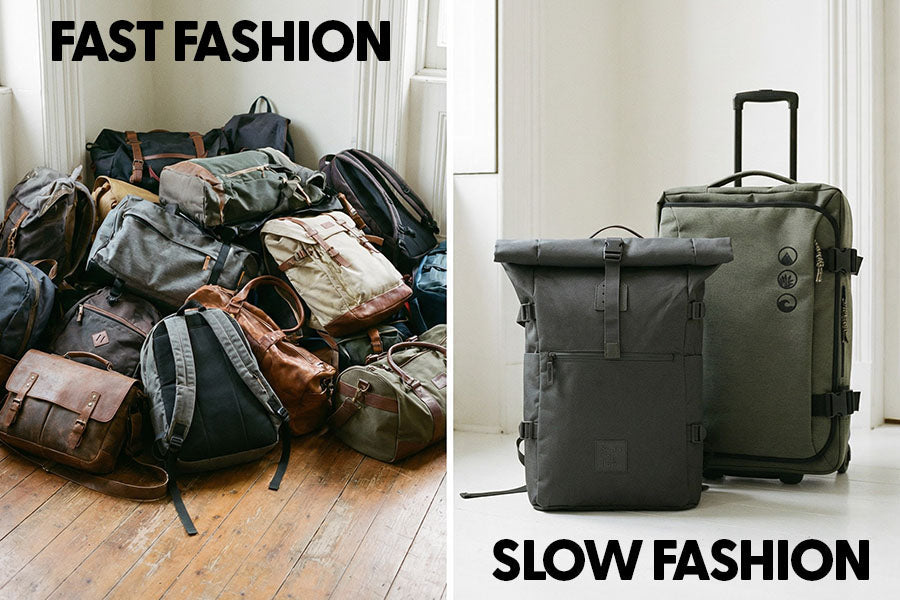
We all know it: one click, one bargain, and three days later you're holding a package in your hand. But the joy often only lasts until the first trip or the first downpour. In the world of Sons of Aloha, we believe that fashion should be more than a short-term dopamine kick. It's about the difference between Fast Fashion, the fast food of the textile industry, and Slow Fashion, the conscious decision for longevity. But have you ever asked yourself what impact your purchasing decisions have on the environment and society?
Slow Fashion emerged as a counter-movement to Fast Fashion. This topic is becoming increasingly important, as sustainable fashion not only protects the environment but also promotes social responsibility. The social relevance of Slow Fashion is evident in the fact that more and more people are consuming more consciously and valuing longevity and fair production conditions.
In the following, we will give you an overview and a summary of the most important differences between Fast Fashion and Slow Fashion.
The Price of Speed: Why "Cheap" Costs Us Dearly
Fast Fashion promises us trends at lightning speed at prices that almost sound too good to be true. And frankly, they are. If a bag costs less than a lavish breakfast, someone else usually pays the price, be it the environment through inferior plastics or the people in production. In the Fast Fashion industry, there are often poor working conditions and enormous pressure on workers in factories to enable the extremely high speed and constant production of new collections. Especially in the case of Ultra Fast Fashion, collections are launched daily to always serve the latest styles and fashion trends and to further boost consumption.
The business model of Fast Fashion is based on producing large quantities of clothing as quickly and cheaply as possible to flood the market with ever new trends. The goal of Fast Fashion brands is to influence consumers' purchasing decisions and continuously increase consumption through low prices and a high frequency of collections. The consequences of this concept are serious: environmental pollution, waste of resources, and social grievances are direct results of this system.
Differences and Concepts: The differences between Fast Fashion and Slow Fashion lie primarily in the concepts, development, and goals. While Fast Fashion focuses on speed, mass production, and short-term fashion trends, Slow Fashion stands for longevity, transparency, fair working conditions, and sustainable consumption. The development of the Slow Fashion movement is largely due to the British scientist Kate Fletcher, who coined the principles for conscious and sustainable fashion consumption. Slow Fashion promotes a growing awareness of the impact of clothing on the environment and society and relies on durable items, fair brands, and ethically run factories.
Slow Fashion, on the other hand, is not a trend, but a way of life. It means:
-
Resource conservation: Use of recycled materials or organic cotton.
-
Fairness: Transparent supply chains (our "Akahai" principle) and fair working conditions in the factories.
-
Quality: Products that do not end up in the trash after one season, but gain character with every adventure and are more sustainable due to their longer lifespan.
Compared to Fast Fashion brands, which focus on fast, cheap production and short product lifecycles, Fair Fashion brands value sustainable materials, fair wages, and transparent production. Criticism of Fast Fashion is growing, as more and more consumers are rethinking their purchasing decisions and contributing to greater sustainability through conscious consumption and small steps in everyday life. Ultimately, when evaluating Fast Fashion and Slow Fashion, the focus should be on the environment, social aspects, quality, and the lifespan of the products.

The Rolltop Backpack: Your Loyal Companion (and Space Wonder)
A perfect example of Slow Fashion in everyday life is the Rolltop Backpack. Why is it so popular? Because it adapts to your life, not the other way around. Whether you're packing just your MacBook for the café or equipment for a weekend trip, the flexible roll system always keeps it compact.
At Sons of Aloha, we rely on materials that deliver what they promise. A high-quality Rolltop Backpack made from recycled fabrics defies the weather and the zeitgeist. It's the answer to the throwaway mentality: invest once, be happy for years.
Tips for a sustainable wardrobe: Consider how you can make your wardrobe more conscious, for example, by buying durable pieces, proper care, or sorting out unused clothes. Also try repairing, swapping, or designing something yourself to make your consumption more sustainable and creative.
Comfort Meets Conscience: Travel Bags with Wheels
Anyone who travels a lot knows: Nothing is more annoying than a jammed wheel or a tearing carrying strap at the gate. High-quality travel bags with wheels are the backbone of any relaxed trip.
While cheap models often give up the ghost after two cobblestone passages, we rely on durability. Our travel bags combine the best of two worlds:
-
Flexibility: The soft material is easier to stow than a hard-shell case.
-
Mobility: Robust wheel systems ensure that you glide effortlessly through train stations and airports.
-
Sustainability: By using durable components, the ecological footprint per trip is minimized. Because the most sustainable bag is the one you don't have to replace.

The Emotional Side of Clothing: Why We Hold Onto Favorite Pieces
Each of us has them, that one jacket, the perfectly fitting T-shirt, or the bag that has accompanied us on countless journeys. They are not just clothes, but mementos that tell stories and make us feel good. This is exactly where it becomes clear how closely our consumer behavior is linked to emotions and appreciation.
In a direct comparison of Fast Fashion vs. Slow Fashion, it becomes clear: While the Fast Fashion industry tempts us with constantly new trends and low prices, the emotional connection often falls by the wayside. The fashion industry focuses on quantity instead of quality, and so many garments end up in the used clothing container after a short time, without ever becoming true favorite pieces.
Slow Fashion, on the other hand, invites us to choose more consciously. Those who opt for a high-quality, durable garment invest not only in quality but also in a story. The transparency of companies, the origin of materials, and fair production play a major role in how much we appreciate a garment. If we know that our new T-shirt is made of organic cotton and produced under fair conditions, it feels much better to wear.
This emotional connection to fashion is an important step towards greater sustainability in the fashion industry. It ensures that we wear our clothes longer, take better care of them, and consume more consciously. Slow Fashion means giving every garment value, and thereby respecting not only the environment but also the people behind the fashion.
Ultimately, it is this appreciation that makes Slow Fashion so special. It transforms fashion from a fast-moving consumer good into a loyal companion that accompanies us on our journey through life, and that is perhaps the most honest form of sustainability.
Quality as a Statement: The "Aloha" Principle
Sustainability is often explained in complicated terms, but at its core, it is simple: Buy less, choose consciously. At Sons of Aloha, our values flow directly into every design. "Lōkahi" (harmony) for us also means harmony between design and nature.
When you choose one of our bags, you are not just buying an accessory. You are choosing against the cycle of waste and for a piece of craftsmanship that accompanies you on your journey, whether that journey leads to the office or to the beach of Maui.
Conclusion: Quality is not a luxury, but a necessity for our planet. Slow Fashion is the most honest form of appreciation, for the product, for the makers, and for yourself.


Share :
New arrivals at Sons of Aloha: This is how sustainable travel & streetwear should be!
Spring Reset: Your Backpack Upgrade for More Flow in Everyday Life